
Public records for journalists are government-created documents, filings, and databases reporters use to verify claims, authenticate documents, trace financial and ownership relationships, and produce evidence-based reporting grounded in primary sources rather than unverifiable assertions.
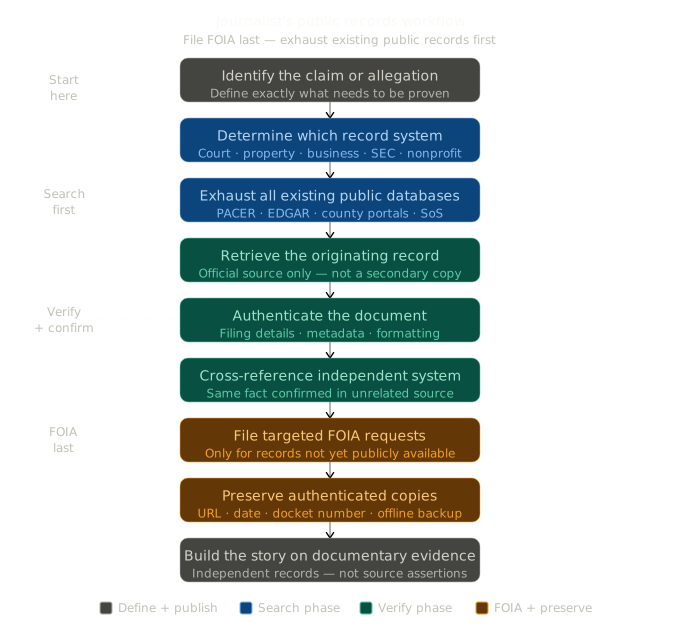
Quick Answer: Investigative journalists use public records to confirm facts that cannot be reliably established through interviews alone. The process begins by identifying a claim, determining which government system would document it, retrieving the originating record, verifying authenticity, and confirming through at least one independent record system. The core toolkit includes court records, property records, business filings, nonprofit Form 990 disclosures, FOIA requests, SEC filings, and campaign finance databases. When multiple independent records confirm the same fact, the claim is documentable.
Public records are the backbone of investigative journalism because they were created for legal or regulatory purposes — not for publicity. A deed exists because property ownership changed. A court filing exists because a legal claim was filed. A Form 990 exists because tax law requires disclosure. These records are generated independently of a journalist’s reporting, which is what makes them reliable. They provide documentary evidence that editors, fact-checkers, and readers can verify independently long after a story publishes.
⚠️ Legal Notice: Federal Freedom of Information Act requests are governed by 5 U.S.C. § 552 and apply to federal executive branch agencies — not courts or Congress. This guide explains public-records methodology for journalism and does not constitute legal advice.
Why This Guide Is Reliable
inet-investigation.com publishes research-based guides built on primary government sources, investigative practice, and public records law. All sources cited link to official government websites or primary legal references. For jurisdiction-specific legal questions, consult a licensed attorney or the relevant government agency.
Why Public Records Are the Foundation of Investigative Journalism
Public records provide three advantages no other source fully replicates.
Independence — records exist whether or not sources cooperate. A company executive who refuses to comment still filed incorporation documents with the Secretary of State. Documentary evidence doesn’t require anyone’s cooperation.
Verification — claims can be confirmed through official filings that predate the reporting. A document in the official government repository, with the correct filing date and docket number, is far harder to dispute than a source’s recollection.
Documentation — stories built on primary records are harder to dispute after publication. When editors, lawyers, and readers can independently verify the same record, the reporting stands on its own.
Many major investigations rely on records long before sources speak publicly — the documents often surface the story that sources then confirm, rather than the reverse.
The Legal Framework
| Law | What It Covers | Relevance |
|---|---|---|
| Freedom of Information Act (FOIA) | Public access to federal executive agency records | Primary tool for obtaining unpublished federal records |
| Privacy Act of 1974 | Limits federal disclosure of records about individuals | Affects what agencies can release in FOIA responses |
| Driver’s Privacy Protection Act (DPPA) | Restricts motor vehicle record disclosure | Limits access to DMV records |
| State open records laws | Govern state and local agency records | Each state has its own sunshine law — varies widely in strength |
| Reporter’s Privilege / Shield Laws | Protects journalists from compelled source disclosure | Varies by state — no comprehensive federal shield law |
Source: Freedom of Information Act — 5 U.S.C. § 552 — Cornell LII
How Journalists Use Public Records Differently
Researchers often search for answers. Journalists search for verifiable proof. That distinction shapes everything.
Source verification — before relying on a source’s claims, reporters confirm that their identity, employer, credentials, and affiliations match public filings independently.
Document authentication — when a source provides a document, journalists verify it appears in the official repository where it should exist before publishing.
Deadline reporting — public records often provide faster authoritative confirmation than waiting for official statements. A court docket confirming a lawsuit was filed is immediate; a spokesperson’s response may take days.
Source protection — records allow verification without exposing confidential sources. If a financial relationship can be documented through property records, court filings, and business registrations found independently, the tip source doesn’t need to be named. The records stand alone.
Record Hierarchy: Strong vs. Weak Sources
Not all records carry the same evidentiary weight. Professional reporting prioritizes by reliability:
Strongest:
- Sworn court filings — submitted under penalty of perjury
- Government regulatory disclosures — Form 990, SEC filings, licensing records
- Official agency databases — PACER, county recorder, Secretary of State
- Statutory filings — corporate registrations, campaign finance disclosures, FOIA documents
Moderate:
- Corporate press releases — self-published, verify independently
- Professional biographies — self-reported leads, not authoritative
- Association directories — useful starting points only
Weakest:
- Social media profiles — easily fabricated or altered
- Personal websites — no independent verification
- Self-reported résumés — the claim itself, not the verification
Always retrieve the primary government record rather than relying on a secondary summary.
What Public Records Cannot Do
Before describing what public records reveal, it’s worth being clear about their limits. Unrealistic expectations produce bad journalism.
Public records cannot prove intent. A transaction in the county recorder or a campaign contribution in FEC data is a fact. What it means requires additional reporting.
Public records are often incomplete. Many records have limited historical coverage. Pre-digital records may not be online. Some jurisdictions have weak disclosure laws. An absence of records is not proof nothing happened.
Public records can contain errors. Government filings are created by humans. A name misspelling, incorrect date, or data entry error in an official record is a mistake — not necessarily a story.
Public records don’t replace interviews. Documentary evidence establishes facts; interviews establish context, motive, and response. Strong investigative journalism uses both.
FOIA has limits. The nine exemptions allow agencies to withhold classified information, law enforcement records, internal deliberations, and personal privacy information. Some agencies are slow, unresponsive, or overly redactive. FOIA is a powerful tool with real constraints.
Understanding what records can’t do makes the reporting more honest and the stories more defensible.
The Journalist’s Public Records Toolkit
Court Records
Court filings contain detailed factual information because statements submitted to court are made under penalty of perjury — giving them significantly more evidentiary weight than voluntary disclosures.
What court records reveal:
- Detailed factual allegations in complaints and counterclaims
- Sworn declarations and affidavits with specific dates, amounts, and relationships
- Financial disclosures in bankruptcy and divorce proceedings
- Employment relationships and contract terms in business litigation
- Exhibits — actual contracts, emails, and internal documents filed as evidence
How journalists use PACER specifically: Rather than searching for a known case, journalists often run name searches across all federal courts to surface unknown litigation involving a subject. The PACER Case Locator (pcl.uscourts.gov) searches all 94 federal districts and all bankruptcy courts simultaneously. For ongoing investigations, PACER case alerts notify reporters when new documents are filed in specific cases. Sealed documents — noted on the docket even when content is inaccessible — are often themselves newsworthy.
→ Related guide: What Is PACER? A Beginner’s Guide to Federal Court Records
→ Related guide: How Court Records Work in the United States
Property Records
County property systems verify ownership, purchase history, mortgages, and liens. For journalists, property records are particularly powerful for reporting on public officials whose financial disclosure statements can be tested against actual recorded ownership — or for tracing asset trails through related-party transactions.
→ Related guide: How Property Records Work in the United States
→ Related guide: How to Find Out Who Owns a Property
Business Records
State business registries confirm whether companies exist and who controls them. Secretary of State filings show formation dates, officers and directors, and corporate status. UCC financing statements reveal lender relationships. Cross-referencing multiple entities through shared registered agents, addresses, and officers surfaces networks that individual filings conceal.
→ Related guide: How to Research a Business and Its Owners
Nonprofit Form 990 Disclosures
Form 990 filings are among the most information-rich public documents available for any organization. Schedule L (transactions with interested persons) and Schedule J (detailed compensation) most frequently surface newsworthy information — insider payments, loans to officers, and compensation that contradicts public messaging. Always compare at least three consecutive years of filings; financial trends and governance changes often become visible only across time.
→ Related guide: How to Investigate a Nonprofit Organization
SEC Filings for Business and Financial Journalism
For any reporting involving publicly traded companies or their executives, SEC EDGAR (sec.gov/edgar) is indispensable.
Key filings for journalists:
- DEF 14A (Proxy statement) — executive biographies, compensation, related party transactions, board composition. The most useful single filing for executive accountability reporting.
- 8-K (Material event disclosure) — required for significant corporate events with precise dates: appointments, departures, mergers, legal proceedings, financial restatements.
- 10-K (Annual report) — Item 3 lists significant pending legal proceedings — a required disclosure of lawsuits the company considers material.
- Form 4 (Insider trading) — executive stock transactions filed within two business days. Patterns of selling before negative news are a recurring investigation trigger.
EDGAR full-text search (efts.sec.gov/LATEST/search-index) searches all SEC filing text for any name or term — including references to individuals in filings they didn’t personally submit.
Campaign Finance Research
Political investigations rely on campaign finance disclosures to document financial relationships between donors, candidates, committees, nonprofits, and corporate entities.
- Federal Election Commission (fec.gov/data) — searchable by donor name, committee, employer, ZIP code, and amount
- OpenSecrets (opensecrets.org) — aggregated FEC data with industry categorization and donor network analysis
- FollowTheMoney (followthemoney.org) — state-level campaign finance data across all 50 states
- State campaign finance portals — search “[state name] campaign finance” for the official state portal
Campaign finance analysis frequently surfaces networks of consultants, donors, nonprofits, and vendors that connect political campaigns to business interests — the kind of undisclosed relationship that becomes a story.
FOIA Strategy for Journalists
The most important FOIA principle: File last, not first.
FOIA requests can take months to years. Many records journalists request are already publicly available through PACER, SEC EDGAR, state court portals, and county databases. Every FOIA request should be preceded by a thorough search of existing public records — not because FOIA isn’t valuable, but because it’s slow, and faster routes to the same information should always be exhausted first.
Before filing any FOIA request:
- Search the agency’s existing FOIA reading room — previously released documents are already available
- Search MuckRock’s public library (muckrock.com) — a platform for filing, tracking, and sharing requests that maintains a public database of what other journalists have already requested and received
- Identify the specific office within the agency most likely to hold the records — a request to the right office processes faster than one routed through central FOIA intake
Writing an effective request:
- Describe records precisely: document type, date range, subject, case number if known
- Avoid “all records” requests — they invite delays and overbroad denials
- Request electronic delivery
- Include a fee waiver: “I am a journalist requesting records for news media purposes. Disclosure is in the public interest because [brief explanation].”
After filing:
- Track the 20-business-day acknowledgment deadline and follow up before it lapses
- Appeal excessive redactions through the administrative appeal process
- Request a Vaughn index when records are withheld — this requires the agency to specifically identify each withheld document and the exemption claimed, which often reveals more than intended
→ Related guide: How FOIA Requests Work
Document Authentication
When a source provides a document, journalists verify it before publishing. Authentication is a distinct skill from records research.
Authentication checklist:
Check the official repository. If it’s a court filing, find it in PACER or the state court portal. If it’s a corporate filing, confirm it in the Secretary of State database. A document that doesn’t appear where it should requires explanation before publication.
Verify filing details. Confirm docket numbers, filing dates, case numbers, and jurisdictional details. An authentic CM/ECF court filing has a timestamp that matches the docket.
Check formatting. Authentic government documents have characteristic formatting, fonts, seals, and stamp positions. Compare against known authentic versions from the same agency.
Examine metadata. PDF metadata is viewable in Adobe Acrobat under Document Properties. Creation date, authoring software, and revision history can reveal inconsistencies — a document supposedly from 2018 whose metadata shows creation yesterday is a significant red flag.
Cross-reference named individuals. Confirm that signatories appear in the correct roles in independent public records during the relevant period.
Preserve everything. Download and save copies with URL, retrieval date, and filing identifier. Government portals change, restrict access, and occasionally remove documents — offline copies are essential.
Source Protection and Public Records
Public records serve a source protection function — they allow reporters to verify information without creating a direct trail back to the confidential source who provided the tip.
Practical considerations:
Keep the tip and the documentary evidence analytically separate in notes. The story should be able to stand on the documentary evidence alone — the source’s role is directing the investigation, not appearing in it.
Know your state’s shield law before the issue arises. Most states have laws limiting when journalists can be compelled to reveal confidential sources, but protections vary widely — some have exceptions for criminal proceedings, some require the journalist to have been engaged in news gathering. Federal courts have no comprehensive shield law. Consult legal counsel before you need it.
Store authenticated copies in secure, encrypted storage. Records preserved locally can’t be accessed through a subpoena to a third-party cloud service.
The Complete Journalist’s Records Workflow
Government Sources
| Database | What It Provides | URL |
|---|---|---|
| PACER | Federal court records | pacer.gov |
| PACER Case Locator | Nationwide federal case search | pcl.uscourts.gov |
| SEC EDGAR | Public company filings | sec.gov/edgar |
| EDGAR full-text search | All SEC filing text search | efts.sec.gov/LATEST/search-index |
| FEC Data | Federal campaign finance | fec.gov/data |
| FOIA.gov | Federal FOIA requests and tracking | foia.gov |
| FBI Vault | Released FBI documents | vault.fbi.gov |
| IRS Tax Exempt Search | Nonprofit status and 990 filings | apps.irs.gov/app/eos |
| SAM.gov | Federal contractor data | sam.gov |
| State court portals | State civil and criminal records | Varies by state |
| County recorder portals | Property records | County websites |
| Secretary of State portals | Business entity filings | State SoS websites |
Journalism Workflow Tools
| Tool | What It Does | Access |
|---|---|---|
| MuckRock | File, track, and share FOIA requests; public request library | muckrock.com — free and paid tiers |
| DocumentCloud | Upload, annotate, and publish primary source documents | documentcloud.org — free for journalists |
| CourtListener / RECAP | Free access to federal court records | courtlistener.com — free |
| ProPublica Nonprofit Explorer | Searchable 990 database | projects.propublica.org/nonprofits — free |
| OpenSecrets | Analyzed FEC campaign finance data | opensecrets.org — free |
| FollowTheMoney | State-level campaign finance data | followthemoney.org — free |
| Wayback Machine | Archived websites for historical research | web.archive.org — free |
DocumentCloud is a document management platform built for journalists — it allows uploading, annotating, redacting, and publishing primary source documents directly alongside news stories. Major newsrooms use it as standard practice for document transparency.
CourtListener / RECAP — a nonprofit providing free access to federal court documents previously downloaded from PACER by any user who installs the RECAP browser extension. For documents already in the archive, it’s free access to records that would otherwise cost PACER fees.
→ Related guide: OSINT Tools for Beginners — [inet-investigation.com] → Related guide: Best Government Databases for Background Research — [inet-investigation.com]
Common Mistakes Journalists Make With Public Records
Trusting a leaked document without verifying the official version. Authentic documents appear where they should in official repositories. Documents that don’t appear there require explanation before publication.
Filing FOIA before exhausting public records. Many records journalists file FOIA requests for are already in PACER, EDGAR, or state databases. File last, not first.
Writing overly broad FOIA requests. “All records related to [subject]” requests invite delays, fee assessments, and overbroad denials. Specific requests produce faster, more complete responses.
Relying on a single database. One database confirming a fact is a lead. Multiple independent databases confirming the same fact is verification.
Treating biographies and press releases as proof. Company-issued materials are self-reported. Verify through independent regulatory records, court filings, or licensing databases.
Ignoring filing dates. When a document was filed matters as much as its content. A filing dated the day before a major transaction tells a different story than one filed months earlier.
Failing to preserve documentation. Government portals change URLs and occasionally remove documents. Download and preserve every record used in a story before publication.
Frequently Asked Questions
What public records do journalists use most? Court records, business filings, property records, nonprofit Form 990 disclosures, SEC filings, and campaign finance records. PACER and SEC EDGAR are the highest-value individual databases for most investigative work.
Do journalists need press credentials to search public records? No. Public records are accessible to anyone unless specifically restricted by law. Being a journalist provides procedural benefits — FOIA fee waivers, news media processing priority — but access itself doesn’t require credentials.
What is the most important public records skill for journalists? Knowing which record system would document a specific claim — and retrieving the originating record from the official source rather than relying on a secondary aggregation.
How long do FOIA requests take? By statute, agencies must acknowledge within 20 business days. Complex requests often take months to years. Targeted, specific requests processed faster than broad ones. File last, not first.
What is DocumentCloud? A platform for uploading, annotating, and publishing primary source documents alongside news stories — allowing readers to examine the underlying records the reporting is built on.
Final Thoughts
Effective investigative reporting built on public records follows a consistent methodology: identify the claim, determine which record system would document it, exhaust existing public databases before filing FOIA requests, retrieve and authenticate the originating record, and confirm through at least one independent system.
When that sequence produces consistent results across independent sources — the same relationship appearing in property records, court filings, and business registrations found separately — the reporting stands on documentary evidence rather than assertion. When it doesn’t produce corroboration, that absence is itself information worth reporting carefully.
The records exist. The reporting skill lies in knowing which system to search, how to read what’s there, and how to build a documented story that stands independently of any single source.
Related Guides
- How FOIA Requests Work
- What Is PACER? A Beginner’s Guide to Federal Court Records
- How Court Records Work in the United States
- How to Research a Business and Its Owners
- How to Investigate a Nonprofit Organization
- OSINT Tools for Beginners
- How Property Records Work in the United States
- Best Government Databases for Background Research
Disclaimer: This article is for informational purposes only and does not constitute legal advice. Public records laws, FOIA procedures, and shield law protections vary by jurisdiction. Consult qualified legal counsel for guidance specific to your reporting situation. This article may contain affiliate links — we may earn a commission if you purchase through them, at no extra cost to you.