
Public records about a person are official documents, filings, and data created or maintained by government agencies in the course of official business — and in the United States, most of these records are legally accessible to anyone who knows where to look.
Quick Answer: Publicly available information about a person typically includes court records, property ownership, criminal history, business registrations, professional licenses, bankruptcy filings, and vital records such as marriages and deaths. Financial accounts, medical records, tax returns, juvenile records, and private communications are generally not public. Because public records are distributed across thousands of separate government systems — not stored in any single database — finding what’s available requires identifying which agencies hold relevant records and searching each system directly.
Many people assume there is a single database containing everything about a person. There isn’t. A systematic government records search requires identifying which agencies hold relevant records and searching each system directly. Public information about individuals is distributed across county recorders, state courts, federal bankruptcy courts, Secretary of State portals, state licensing boards, and dozens of other agencies — each maintaining the records that document its own official actions. A complete picture of what’s publicly available about someone requires systematic searching across multiple systems.
⚠️ Legal Notice: Public records access is governed by federal and state laws designed to balance government transparency with personal privacy. The Freedom of Information Act, state open records laws, FCRA, DPPA, and HIPAA all affect what can be accessed and how it can be used. This guide explains lawful public-records access only and does not constitute legal advice.
Why This Guide Is Reliable
inet-investigation.com publishes research-based guides built on primary government sources, investigative practice, and public records law. All sources cited link to official government websites or primary legal references. For jurisdiction-specific legal questions, consult a licensed attorney or the relevant government agency.
Why This Question Matters
Whether you’re researching someone else or trying to understand what others can find about you, the answer to this question shapes everything about how you approach the search.
For investigators and researchers, knowing what’s publicly available determines which systems to search and what findings to expect. For individuals, knowing what’s in the public record is the first step to understanding your own digital footprint — and correcting inaccurate records before they affect employment, housing, or credit decisions.
The answer is both more and less than most people expect. More, because the combination of court records, property records, business filings, and government databases can produce a remarkably detailed picture of someone’s legal and financial history. Less, because the most sensitive financial information — bank accounts, investment portfolios, tax returns — is specifically protected from public disclosure.
→ Related guide: What Are Public Records?
How Public Records About a Person Are Created
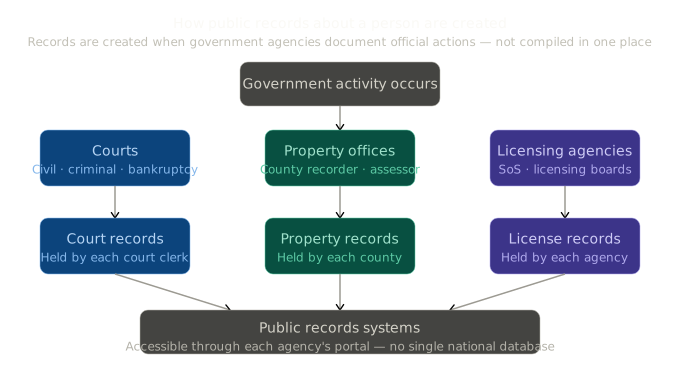
Records about a person are not compiled in one place. They are created when government agencies document official actions — a court files a case, a county records a deed, a state issues a license. Each agency maintains the records it creates, in the jurisdiction where the action occurred. That is why a public records search requires searching multiple systems rather than querying one database.
→ Related guide: How Public Records Are Organized in the United States
The Legal Framework
Public records exist because of a foundational principle in American law: government agencies exercise public authority, spend public money, and make decisions that affect citizens — and the public has a right to observe those actions.
Several federal laws define what’s accessible and how it can be used:
| Law | What It Covers | Relevance |
|---|---|---|
| Freedom of Information Act (FOIA) | Access to federal executive agency records | Allows any person to request federal agency records |
| Privacy Act of 1974 | Limits disclosure of federal records about individuals | Protects certain federal records from unauthorized release |
| Driver’s Privacy Protection Act (DPPA) | Restricts disclosure of motor vehicle and driver records | Limits who can access driver history and vehicle registration |
| Fair Credit Reporting Act (FCRA) | Regulates consumer reporting agencies and background checks | Governs how public records can be used in employment and housing decisions |
| HIPAA | Protects individually identifiable health information | Keeps medical records private regardless of government involvement |
Source: Freedom of Information Act — 5 U.S.C. § 552 — Cornell LII Source: Fair Credit Reporting Act — 15 U.S.C. § 1681 — Cornell LII Source: Driver’s Privacy Protection Act — 18 U.S.C. § 2721 — Cornell LII
Every state also has its own open records law — variously called a Public Records Act, Sunshine Law, or Open Records Law — governing how state and local agencies release records. What’s public in one state may be restricted in another.
What Information About a Person Is Typically Public
Court Records
Court records are among the most information-rich public records available. Every civil lawsuit, criminal prosecution, eviction filing, bankruptcy case, divorce proceeding, and probate matter produces a court record — and most are publicly accessible.
For investigators, court records reveal legal disputes, financial obligations, business conflicts, fraud allegations, and criminal history in a level of detail that commercial background check tools rarely replicate. A civil complaint filed by a defrauded business partner may describe financial relationships and alleged misconduct in specific detail. A bankruptcy filing contains a complete financial disclosure under oath. A sentencing memorandum may document a defendant’s full financial and personal history.
Federal court records are searchable through PACER (pacer.gov). State court records require searching each state’s court portal or county clerk system separately.
→ Related guide: How Court Records Work in the United States — [inet-investigation.com] → Related guide: How Public Records Are Organized in the United States — [inet-investigation.com]
Criminal Records
Criminal records — arrests, charges, court case outcomes, and conviction records — are generally public for adult cases in most jurisdictions. However, juvenile records, sealed cases, and expunged records are typically restricted.
The key distinction: an arrest record does not establish guilt. A criminal records search that reveals an arrest without a conviction tells you that law enforcement took someone into custody — not that they committed a crime. The court disposition is what matters.
There is no national public criminal database. State court portals are the primary source for state criminal records. PACER covers federal criminal prosecutions. The Federal Bureau of Prisons (bop.gov) confirms federal incarceration history. The National Sex Offender Public Website (nsopw.gov) aggregates state sex offender registries.
→ Related guide: What Criminal Records Are Public?
→ Related guide: Jail Records vs. Prison Records
Property Records
Property ownership, deed history, mortgages, and liens are public records maintained by county recorders and county assessors. Most county property records are searchable online at no cost through official county portals.
For investigators, property records reveal current and historical ownership, financing relationships, legal claims against the property, and asset information that appears nowhere else. A lien search reveals unpaid judgments, tax delinquencies, and contractor disputes. A chain of title search can reveal asset transfers to related parties before litigation.
→ Related guide: How Property Records Work in the United States
→ Related guide: What Is a Lien Record?
→ Related guide: Understanding Parcel Numbers
Business and Professional Records
Individuals who form business entities or hold professional licenses appear in government databases. Corporate registrations, LLC filings, and partnership documents are maintained by the Secretary of State in the state of formation. Professional licenses — for attorneys, physicians, contractors, real estate agents, and hundreds of other regulated occupations — are maintained by state licensing boards.
These records verify whether a business is legitimately registered, identify who controls it, and confirm whether a professional holds a valid license in their claimed field. Both are generally free to search through official state portals.
Bankruptcy Records
Personal bankruptcy filings are federal court records searchable through PACER. Bankruptcy schedules require complete financial disclosure under oath — assets, debts, creditors, income, and recent financial transactions. For financial investigations, a bankruptcy filing is often the most detailed financial snapshot available in any public record system.
→ Related guide: What Is PACER? A Beginner’s Guide to Federal Court Records
Vital Records
Vital records document major life events. Access rules vary significantly by state and record type.
| Record Type | Typical Public Availability |
|---|---|
| Birth certificates | Usually restricted — often limited to the subject or immediate family |
| Death records | Generally public, often after a waiting period |
| Marriage records | Public in most states, searchable through county clerk portals |
| Divorce records | Public in most states, held by the court that handled the proceeding |
Voter Registration
Some states allow limited public access to voter registration information — typically confirming registration status, party affiliation, and voting district. Many states restrict how voter data can be used. Rules vary significantly and some states have moved toward greater restrictions in recent years.
Sex Offender Registry
The National Sex Offender Public Website (nsopw.gov) is free to search and aggregates state registry information. State registries typically provide more detailed information than the national portal.
Incarceration Records
County jail booking logs are published by many sheriff’s offices. State prison records are searchable through state Department of Corrections inmate locators. Federal incarceration records are searchable at bop.gov.
→ Related guide: Jail Records vs. Prison Records
What Is NOT Publicly Available
Certain personal information is specifically protected from public disclosure regardless of how it was created or processed.
| Protected Information | Governing Protection |
|---|---|
| Social Security numbers | Redacted from public records under federal law |
| Bank account and financial account numbers | Financial privacy laws |
| Medical records and health information | HIPAA |
| Federal tax returns | IRS privacy rules — not public records |
| Juvenile court records | Sealed in most states to protect minors |
| Sealed and expunged court records | Court-ordered confidentiality |
| Adoption records | Restricted in most states |
| Credit scores and credit reports | FCRA — not public records |
| Private communications | ECPA protections |
| Driver’s license numbers and driving records | DPPA restrictions |
An important practical point: the absence of information in a public records search doesn’t confirm it doesn’t exist. Records may be sealed, held in a jurisdiction not yet searched, or predating digital availability.
The Gap Between Legally Public and Practically Findable
One of the most important distinctions in public records research is the difference between what is legally public and what is practically findable online.
A record can be legally public but practically difficult to find because it’s held in a county that hasn’t digitized its archives, requires a formal records request rather than an online search, is stored in a physical courthouse archive, or is indexed under a business entity name rather than an individual’s personal name.
Conversely, information that has been aggregated by commercial data brokers may appear easily searchable online even when the underlying government records require significant effort to locate directly. Commercial tools create the impression of comprehensive information that individual government portals might not.
For researchers, this means: what shows up in a quick commercial search is not necessarily everything that’s publicly available — and what’s publicly available is not necessarily everything that can be found about a person with systematic research.
How Data Brokers Use Public Records
Commercial people-search services — BeenVerified, Spokeo, Intelius, WhitePages, and many others — compile personal profiles by aggregating data from multiple public records sources. A public records lookup through a commercial aggregator typically draws from county property records, court systems, voter registration databases, business filings, and other government sources, then adds commercially purchased data to create searchable profiles.
The result is that information about most adults in the United States is compiled in searchable databases that anyone can access for a subscription fee or per-report charge. These profiles typically include current and historical addresses, associated phone numbers, email addresses, relatives, property ownership, business associations, and court history.
Several important limitations apply. Commercial databases may be weeks or months out of date. They may miss entire jurisdictions or record types. They may continue displaying records that have been sealed or expunged. And they explicitly prohibit use of their results for employment, housing, or credit screening — these are personal research tools, not FCRA-compliant Consumer Reporting Agencies.
For authoritative results, official government portals are always more current and more reliable than any commercial aggregator.
→ Related guide: OSINT Tools for Beginners
How to Find Out What’s Publicly Available About Someone
The most systematic approach to a public records search starts with government sources and uses commercial tools only to identify additional jurisdictions to search.
Step 1 — Search federal court records through PACER. Go to pcl.uscourts.gov and search the full name through the PACER Case Locator. Search with and without middle name or initial. Run a separate bankruptcy search.
Step 2 — Search state court portals. For each state where the subject has lived, a state records search through the court portal or county clerk system is the next step. No statewide portal? Search each county separately.
Step 3 — Search county property records. Go to the county recorder and county assessor portals for every county where the subject has lived or may own property. Search by name and all known entity names.
Step 4 — Search business filings. Search the Secretary of State portal in every state where the subject may have formed a business entity. Check professional licensing boards for any licensed occupation.
Step 5 — Check criminal and custody records. Search the sex offender registry at nsopw.gov. Check bop.gov for federal incarceration. Search state DOC inmate locators for each relevant state.
Step 6 — Use commercial tools to identify gaps. A people-search tool can supplement a public records search by surfacing address history, associated names, and phone numbers that suggest additional jurisdictions to search. Use those as leads — verify through official government sources.
Step 7 — Search for yourself. Run your own name through all the same systems. What you find is what others can find about you.
→ Related guide: How to Find Someone’s Address Using Public Records
→ Related guide: Best Public Records Databases for Investigations
Personal Research vs. Formal Screening: The FCRA Distinction
How you use the information you find depends on your purpose — and the law treats these purposes differently.
Personal research — researching a person for your own informational purposes is generally lawful using public records and open-source information. No special authorization is required. This covers curiosity searches, due diligence on a potential business partner, or investigating your own record.
Formal screening decisions — using background check information to make employment, housing, credit, or insurance decisions is governed by the FCRA. These decisions require using an FCRA-compliant Consumer Reporting Agency, obtaining written consent from the subject, providing proper disclosures, and following adverse-action procedures if the decision is negative.
Consumer people-search tools are explicitly not for formal screening decisions. Their terms of service prohibit this use, and using them for employment or housing screening violates federal law. For formal screening, use a dedicated FCRA-compliant service.
→ Related guide: What Is a Background Check?
Free Government Sources
| Source | What It Covers | URL |
|---|---|---|
| PACER | Federal court and bankruptcy records | pacer.gov |
| PACER Case Locator | Nationwide federal case search | pcl.uscourts.gov |
| National Sex Offender Public Website | Sex offender registry | nsopw.gov |
| Federal Bureau of Prisons | Federal inmate search | bop.gov |
| State court portals | State civil and criminal records | Varies by state |
| County recorder portals | Property deeds, mortgages, liens | County websites |
| County assessor portals | Property tax and ownership records | County websites |
| Secretary of State portals | Business filings | State SoS websites |
| State DOC inmate locators | State prison custody records | Varies by state |
Free vs. Paid Tools
| Tool | Price | Best Use | FCRA Status |
|---|---|---|---|
| Government portals (above) | Free | Authoritative primary source records | Official sources |
| BeenVerified | ~$26/month | Multi-state aggregated searches | Not FCRA compliant |
| Spokeo | ~$14/month | Address and identity aggregation | Not FCRA compliant |
| Intelius | $7–$20/report | Individual record lookups | Not FCRA compliant |
| TruthFinder | ~$28/month | Consumer background reports | Not FCRA compliant |
| Whitepages Premium | ~$5/report | Address and phone lookup | Not FCRA compliant |
| TransUnion SmartMove | $25–$40/report | Tenant screening | FCRA compliant |
| Checkr | Custom pricing | Employment screening | FCRA compliant |
| LexisNexis Accurint | Custom pricing | Professional multi-jurisdiction research | Professional platform |
Common Mistakes That Produce Incomplete Results
Assuming one search covers everything. No single database contains all public records. A search of BeenVerified, PACER, or any single state court portal covers only a fraction of what may exist. A person with history across multiple states requires searching each state’s systems separately.
Treating commercial database results as authoritative. Commercial tools aggregate data from public records but introduce their own lag times, coverage gaps, and data quality issues. They may display outdated addresses, miss recent filings, or continue showing records that were sealed or expunged. Government portals are always more current and authoritative.
Confusing arrests with convictions. An arrest record documents a custody event — not a judicial determination of guilt. A dismissed case, a no-filed arrest, or an acquittal all produce court records without establishing criminal liability. Always verify the court disposition before drawing conclusions.
Not searching for entities. Properties held in LLCs, businesses formed in a subject’s name, and professional licenses may not appear in a personal name search. A complete search requires identifying all business entities associated with the subject and searching those names separately.
Searching only the current state. Public records follow where events occurred, not where someone currently lives. Court records, property records, and criminal history from prior states require searching those states’ systems directly.
Frequently Asked Questions
Is there a single database with all public information about a person? No. Public records are distributed across thousands of federal, state, and county government systems. Finding what’s available requires searching multiple agencies across multiple jurisdictions.
Can you find someone’s home address through public records? Sometimes. Property ownership records include the owner’s name and the property address. Voter registration records may include a residential address in states that allow public access. Court records may contain addresses listed in filings. However, not all addresses appear in public records, and some are specifically protected.
Are background check results public records? Background check reports themselves are not public records — they are compiled reports created by consumer reporting agencies. However, the underlying information in those reports originates from public records: court filings, property records, business registrations, and government databases.
What’s the difference between what’s public and what shows up on a Google search? Google indexes publicly available web content — which includes some public records that have been published online, news articles, social media profiles, and other information. But many public records — particularly court filings, property records, and government databases — are not indexed by Google and require searching the relevant government portal directly.
Can someone find out what public records exist about me? Yes. Anyone can search the same government portals and commercial tools you would use to research someone else. Running your own name through PACER, state court portals, county property records, and people-search tools shows you what others can find.
Can I have public records about myself removed? Some records can be sealed or expunged through legal processes — court records in particular. Commercial data broker profiles can often be removed through opt-out processes, though the underlying government records remain. Laws governing removal vary significantly by state and record type.
Final Thoughts
Public records about a person can reveal a detailed picture of their legal history, financial position, property ownership, and business activities — when searched systematically across the right government systems. The combination of court records, property records, business filings, and criminal history databases produces more information than most people realize is publicly available.
At the same time, the most sensitive financial information is specifically protected: bank accounts, investment portfolios, tax returns, and medical records are not public records and cannot be obtained through public records systems.
The most important principle remains the same as in every other area of public records research: records are maintained by the agency that created them, in the jurisdiction where the action occurred. Finding what’s available requires knowing which agencies to search — and conducting a government records search at each one directly rather than relying on any single commercial aggregator.
Related Guides
- What Are Public Records?
- How Public Records Are Organized in the United States
- How to Look Up Criminal Records Online
- Jail Records vs. Prison Records
- What Is a Background Check?
- How Court Records Work in the United States
- How Property Records Work in the United States
- OSINT Tools for Beginners
- How Asset Searches Work
- How to Find Someone’s Address Using Public Records
Disclaimer: This article is for informational purposes only and does not constitute legal advice. Laws and access rules vary by jurisdiction. Consult a licensed attorney for guidance specific to your situation. This article may contain affiliate links — we may earn a commission if you purchase through them, at no extra cost to you.