Business research is the process of identifying how a company is structured, who owns or controls it, and what public records reveal about its operations, legal history, and financial risk — by following the official filings that business activity must create to be legally effective.
Quick Answer: To research a business, start with the state Secretary of State business registry to confirm the legal entity name, formation date, registered agent, and filing status. Then expand into UCC financing statements, licensing records, court records, lien filings, and federal databases such as SEC EDGAR or SAM.gov when relevant. If ownership is obscured behind LLCs or layered entities, compare addresses, registered agents, signatories, officers, and litigation records across multiple filings — when the same names and addresses appear repeatedly across independent systems, the underlying ownership structure becomes visible.
A company’s website, trade name, and storefront tell you how a business presents itself. The filings tell you what it actually is. Every business that legally exists was registered somewhere, every loan was secured somewhere, every lawsuit was filed somewhere, and every license was issued somewhere. The paper trail is always there — distributed across multiple government systems rather than gathered in one place.
⚠️ Legal Notice: Business filings and court records are public in most jurisdictions but governed by state laws and privacy rules. The FCRA restricts how certain business research findings can be used in employment, housing, and credit decisions. Federal tax liens arise under 26 U.S.C. § 6321. This guide explains lawful public-records research methods and does not constitute legal advice.
Why This Guide Is Reliable
inet-investigation.com publishes research-based guides built on primary government sources, investigative practice, and public records law. All investigative techniques described here rely on records created by government agencies responsible for maintaining business and legal filings. For jurisdiction-specific legal questions, consult a licensed attorney or the relevant government agency.
Why Business Research Matters
Due diligence — before signing contracts, making investments, or entering partnerships, verifying whether a company legally exists, is in good standing, holds required licenses, and has major legal or financial problems is basic risk management. Many business fraud victims could have avoided losses with a 30-minute public records check.
Fraud detection — fraud investigations frequently involve businesses created to conceal ownership, move assets, or appear legitimate while conducting fraudulent operations. Public records reveal shell companies, nominee ownership, repeated litigation, and large outstanding debts.
Journalism and accountability research — reporters investigating companies tied to political donors, public officials, government contractors, and regulatory enforcement actions rely on the same business records workflow described here.
Legal investigations — attorneys and investigators examine business records to identify assets, affiliated companies, responsible officers, and litigation history for litigation support, judgment collection, and pre-litigation due diligence.
→ Related guide: How Asset Searches Work
→ Related guide: How to Find Out Who Owns a Property
The Legal Framework
| Law / Source | What It Covers | Relevance |
|---|---|---|
| State business corporation acts | Require entity registration and annual reporting | Make business filings publicly searchable |
| UCC Article 9 | Governs secured transactions | Makes lender-debtor relationships publicly recordable |
| 26 U.S.C. § 6321 | Federal tax lien statute | Federal tax liens attach to business assets and are publicly recorded |
| Securities Exchange Act | Governs public company disclosure | Requires SEC EDGAR filings for publicly traded companies |
| Corporate Transparency Act (2024) | Requires beneficial ownership disclosure to FinCEN | Creates federal ownership records — not publicly accessible |
| Fair Credit Reporting Act (FCRA) | Regulates consumer reporting | Governs how business research can be used in formal screening decisions |
Source: Federal Tax Lien — 26 U.S.C. § 6321 — Cornell LII Source: Fair Credit Reporting Act — 15 U.S.C. § 1681 — Cornell LII
Corporate Transparency Act note: The 2024 CTA requires most LLCs and corporations to file beneficial ownership information with FinCEN. However, this database is not publicly accessible — it is available only to law enforcement and financial institutions under specific circumstances. For public business research, state filings, UCC records, and court documents remain the primary tools. The FinCEN database provides no benefit to public investigators.
The Core Rule: Follow the Filings, Not the Branding
A company’s website, trade name, or storefront does not identify the legal entity behind it. Businesses routinely operate through trade names, holding companies, subsidiary LLCs, layered corporate structures, and nominee arrangements.
Investigations start with the legal entity filing — not the marketing name. The goal is to determine what the legal entity actually is, whether it is active, who signs for it, which addresses and agents appear repeatedly, and which other entities share those connections.
The same principle that applies to property research applies here: ownership is found by following documents, not names alone.
Federal vs. State Business Records
Most business records are state-level. Companies register with state governments — usually through the Secretary of State — which establishes legal entity existence, formation date, registered agent, and corporate status.
Federal databases apply only when businesses interact with federal systems: SEC EDGAR for public companies, PACER for federal lawsuits and bankruptcy, SAM.gov for federal contractors, and FTC enforcement records for regulatory actions. For most private businesses, the state registry is the primary — and often only — starting point.
Secretary of State Filings: The Starting Point
Every business research investigation begins with the Secretary of State business registry for the state where the company was formed. These databases are free and publicly accessible.
What state business filings typically contain:
- Legal entity name and any registered trade names
- Formation date and jurisdiction
- Registered agent name and address
- Principal office address
- Officers, directors, or members (varies by state and entity type)
- Filing and annual report history
- Current status (active, dissolved, revoked, administratively dissolved)
Key Secretary of State portals:
| State | Portal | URL |
|---|---|---|
| Delaware | Division of Corporations | icis.corp.delaware.gov |
| California | Business Search | bizfileonline.sos.ca.gov |
| Texas | SOSDirect | mycpa.cpa.state.tx.us/coa/Index.html |
| Florida | Sunbiz | search.sunbiz.org |
| New York | Corporation Search | apps.dos.ny.gov/publicInquiry |
| Illinois | Business Entity Search | ilsos.gov/corporatellc |
| Nevada | SilverFlume | esos.nv.gov |
| Wyoming | Business Center | wyobiz.wyo.gov |
For any other state, search “[state name] Secretary of State business search” to find the official portal. All 50 states provide free public access to business entity searches.
Search tips:
- Search the exact legal name and separately search partial name variants
- Search officer and manager names — a person who controls multiple companies appears across multiple filings
- Search registered agent names — a registered agent serving dozens of LLCs at the same address may be a commercial filing service or a deliberate anonymity structure
- Search for DBA (doing business as) or assumed name filings — the trade name a company uses publicly may be registered separately from the legal entity name
Note on privacy states: Delaware, Wyoming, Nevada, and New Mexico allow maximum formation privacy — LLCs formed in these states may list only a registered agent with no members, managers, or officers in the public filing. When the SoS filing is unhelpful, the investigation shifts entirely to UCC filings, court records, and property documents.
Business Structure Types and What They Reveal
| Entity Type | Typical Public Disclosure | What It Reveals |
|---|---|---|
| LLC | Varies by state — some list members/managers, some only registered agent | Formation state determines disclosure level — Delaware/Wyoming minimal |
| Corporation | Officers and directors usually listed in annual reports | More consistent disclosure than LLCs |
| Public corporation | Extensive SEC filings required | Full financial disclosure, executive compensation, litigation |
| Partnership | Partners or managing partners often listed | Common in professional services and investment funds |
| Sole proprietorship | Usually only DBA or local license filing | Personal name of owner often visible |
| Nonprofit | IRS Form 990 required | Officers, financials, and mission publicly disclosed |
Legal Ownership vs. Control vs. Beneficial Ownership
These three roles are not always held by the same person — and the distinction is investigatively critical.
Legal ownership — the name appearing on the official filing. May be an LLC, a trust, or a nominee individual.
Control — the person managing or directing the business day-to-day. May be a manager, director, or authorized signatory who isn’t the legal owner.
Beneficial ownership — the person who ultimately benefits financially from the business. May be entirely invisible in official filings.
An LLC may legally own a business while a manager controls it and a silent partner benefits financially. Investigators identify these relationships by comparing multiple independent records rather than relying on any single filing. The same individual appearing as a signatory across multiple entity filings, a registered agent across multiple LLCs, and a deed signatory on related property transactions is almost certainly the controlling beneficial owner — regardless of what the entity filing lists.
UCC Financing Statements
UCC (Uniform Commercial Code) financing statements are public records filed with the Secretary of State that provide notice that a lender claims a secured interest in a debtor’s assets.
Where to search: Most states maintain UCC filing search tools on the same Secretary of State portal as business entity searches. Search “[state name] UCC filing search” for the relevant portal.
What a UCC filing reveals:
- Debtor legal name and address — confirms the correct legal entity name
- Secured party (lender/creditor) name and address — identifies who is financing the business
- Collateral description — describes the assets pledged (equipment, inventory, accounts receivable, intellectual property)
- Filing date and continuation history — shows how long the financing relationship has existed
What investigators learn from UCC filings:
- Which lenders are financing the business — banks, alternative lenders, factoring companies
- What assets the business owns that are significant enough to pledge as collateral
- Whether the business is factoring receivables — a sign of cash flow pressure
- Whether the same individual appears as debtor across multiple business entities
Important limitation: A UCC filing does not indicate financial distress. Most healthy businesses have UCC filings reflecting normal commercial lending. The significance increases when UCC filings appear alongside litigation, tax liens, and collection lawsuits.
Business Licenses and Professional Licenses
Many businesses and their key personnel require licenses from state or local regulators. These records are publicly searchable and often reveal the responsible individuals behind a business entity.
Common licensed professions and industries:
- Contractors and construction — state contractor licensing boards
- Healthcare — medical, dental, and nursing boards
- Legal — state bar association portals
- Real estate — state real estate commission portals
- Financial services — FINRA BrokerCheck (brokercheck.finra.org) for securities professionals
- Insurance — state insurance commissioner portals
- Food service — local health department permits
What license records reveal:
- The named individual holding the license — often the actual owner or principal
- License status (active, suspended, revoked, expired)
- Disciplinary actions and license restrictions
- Issue and renewal dates
- Primary business address
A business claiming specialized expertise in a licensed field should always be verified through the relevant licensing board. Revoked or suspended licenses, disciplinary actions, and license renewals that stopped years ago are all meaningful findings.
Court Records for Business Litigation
Court records frequently reveal more about a company than its own filings — particularly patterns of behavior that no voluntary disclosure would contain.
Federal courts (PACER):
- Bankruptcy filings — the most financially detailed public record for any business
- Securities litigation — fraud allegations, SEC enforcement referrals
- Intellectual property disputes
- Federal fraud and wire fraud cases
State courts:
- Breach of contract and vendor disputes
- Employment litigation
- Collections lawsuits — repeated collections suits against a business are a significant red flag
- Fraud allegations from customers, partners, or employees
- Dissolution disputes between owners
What to look for in court records:
- Is the business primarily a plaintiff, defendant, or debtor?
- Are there repeated claims from the same type of counterparty (vendors, employees, customers)?
- Do officers appear personally in litigation alongside the company?
- Are there fraud or intentional tort allegations — not just breach of contract?
→ Related guide: How Court Records Work in the United States
→ Related guide: What Is PACER? A Beginner’s Guide to Federal Court Records
Tax Liens and Judgment Liens Against Businesses
Federal tax liens (26 U.S.C. § 6321) arise when a business fails to pay federal taxes after demand. These liens attach to all business property and are recorded in county recorder indexes — searchable by business entity name or responsible officer name.
State tax liens — most states also record tax liens through the Secretary of State or county recorder when state taxes go unpaid.
Judgment liens — when a business loses a civil lawsuit and fails to pay the judgment, the winning party can record a judgment lien against the business’s assets. Repeated judgment liens across multiple counties indicate a business that consistently fails to pay its obligations.
IRS IDRS — the IRS maintains a centralized federal tax lien database, but the public-facing search is through county recorder portals and the Secretary of State in some states.
Federal Agency Records
SEC EDGAR (Public Companies)
URL: sec.gov/edgar Cost: Free
SEC EDGAR is the primary source for public company research. Filed documents include annual reports (10-K), quarterly reports (10-Q), material event disclosures (8-K), insider trading reports (Form 4), and proxy statements (DEF 14A).
For business investigators, the most useful filings are the annual 10-K (comprehensive financial disclosure, litigation disclosures, risk factors), proxy statements (executive compensation, related party transactions, board composition), and 8-K filings (material events including legal proceedings and executive departures).
EDGAR full-text search (efts.sec.gov/LATEST/search-index) — searches the text of all SEC filings for any name, company, or term. Useful for finding references to specific individuals or companies in SEC filings they didn’t themselves submit.
SAM.gov (Federal Contractors)
URL: sam.gov Cost: Free
SAM.gov (System for Award Management) is the federal government’s database of registered contractors, grantees, and vendors. It also publishes the Exclusions list — businesses and individuals debarred or suspended from receiving federal contracts.
What SAM.gov reveals:
- Whether a company is registered to receive federal contracts
- The company’s CAGE code and DUNS number
- Active exclusions and debarment status
- Primary contact information
- Business size and socioeconomic categories
A company claiming federal contractor status that isn’t registered in SAM.gov is either lying about its work or operating informally. A company appearing on the Exclusions list has been found to have committed fraud, violated contract terms, or engaged in other disqualifying conduct.
FTC Enforcement Actions
URL: ftc.gov/enforcement Cost: Free
The FTC publishes enforcement actions for consumer protection violations, deceptive trade practices, privacy violations, and antitrust matters. Searching the FTC enforcement library for a company name surfaces any regulatory actions the FTC has taken.
CFPB Enforcement Actions
URL: consumerfinance.gov/enforcement Cost: Free
The Consumer Financial Protection Bureau publishes enforcement actions against financial services companies. Useful for investigating lenders, debt collectors, and financial product providers.
How to Connect a Business to Its Real Owners
The hidden owner example from the draft illustrates the core technique precisely. No single record reveals beneficial ownership — but the same individuals appear repeatedly across independent filings.
The cross-referencing method:
- Find the entity in the SoS filing — note the registered agent and any listed officers
- Search UCC filings for the entity — note the debtor address and secured party
- Search court records for the entity name — note who signs court documents on behalf of the company
- Search property records for the business address — who owns the building?
- Search licensing records — who holds the individual licenses required for the business?
- Search for related entities — does the same registered agent, address, or signatory appear across other companies?
When the same individual appears as deed signatory, UCC debtor contact, litigation representative, and license holder across multiple independent filings, that person is almost certainly the controlling owner — regardless of what the entity filing lists.
→ Related guide: OSINT Tools for Beginners
→ Related guide: How Investigators Verify Someone’s Identity
Nonprofit Research: Form 990
Nonprofit organizations are a distinct category of business research with unique public disclosure requirements. Most nonprofits with annual revenue over $50,000 must file IRS Form 990 — a comprehensive annual disclosure covering finances, governance, compensation, and program activities.
Where to find Form 990 filings:
- ProPublica Nonprofit Explorer (projects.propublica.org/nonprofits) — free searchable database of nonprofit 990 filings
- Candid/GuideStar (candid.org) — comprehensive nonprofit research database
- IRS Tax Exempt Organization Search (apps.irs.gov/app/eos/) — official IRS portal for nonprofit status verification
Form 990 filings reveal officer compensation, related party transactions, program spending vs. administrative overhead, governance policies, and the names of board members and key employees. For journalism and accountability research, nonprofit 990 filings are among the most information-rich public documents available for any organization type.
Newspaper and Media Archive Research
Government filings reveal structure. Media archives reveal history — previous company names, ownership changes, major lawsuits, criminal allegations, executive departures, and the real-world story behind the business.
Free and low-cost newspaper archive tools:
- Library of Congress Chronicling America (chroniclingamerica.loc.gov) — historical newspapers free
- Google News Archive — historical news search
- ProPublica (propublica.org) — investigative journalism database
Paid newspaper archive tools:
- Newspapers.com — large historical archive
- GenealogyBank — historical newspaper database
What to search:
- The exact legal entity name
- All known trade names and DBA names
- Owner and officer names combined with the business name
- The business address
Media research often surfaces information that no government filing contains — a bankruptcy that was covered in local news before it appeared in PACER, a fraud allegation that resulted in a civil settlement rather than a public court judgment, or a pattern of ownership changes that connects a current company to a previous failed entity.
The Complete Business Research Workflow
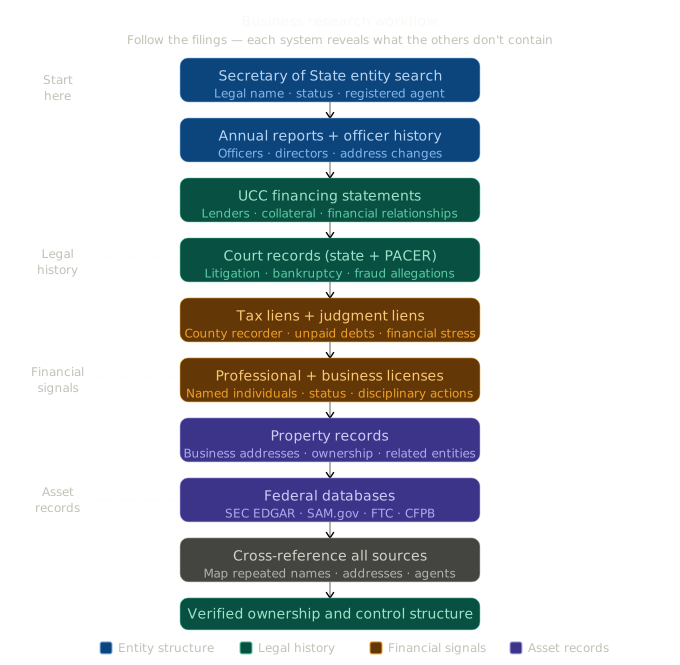
Each system contributes different information. Together they reveal what the business actually is, who controls it, and whether it presents meaningful risk.
Common Red Flags in Business Research
Recently formed companies involved in large transactions — a company formed weeks before a major contract, investment, or transaction deserves scrutiny.
Repeated changes in officers or addresses — frequent turnover in named officers or address changes across multiple filings may indicate instability or deliberate obfuscation.
Revoked or administratively dissolved status — a company that failed to file required annual reports and lost its legal standing is not a legitimately operating business.
Multiple related companies sharing the same address — a residential address or mailbox service hosting dozens of LLCs is a significant flag.
Officers appearing across many failed companies — individuals who have served as officers of multiple businesses that ended in bankruptcy, dissolution, or fraud litigation deserve additional scrutiny.
Repeated fraud or collections litigation — a business that is regularly sued for fraud or non-payment of debts has a documented pattern that no single record captures alone.
Professional claims that don’t match license records — a contractor who claims to be licensed and bonded when no license appears in the state licensing database is making a false claim.
Government contractor claims without SAM.gov registration — a company claiming active federal contracts that doesn’t appear in SAM.gov either isn’t registered or is misrepresenting its work.
Free Government Sources
| Source | What It Covers | URL |
|---|---|---|
| NASS state registry directory | Links to all 50 state SoS portals | nass.org/business-services/corporate-registration |
| NASS UCC search directory | Links to all 50 state UCC search portals | nass.org/business-services/ucc-filings |
| PACER | Federal court records and bankruptcy | pacer.gov |
| PACER Case Locator | Nationwide federal case search | pcl.uscourts.gov |
| SEC EDGAR | Public company filings | sec.gov/edgar |
| EDGAR full-text search | Searches all SEC filing text | efts.sec.gov/LATEST/search-index |
| SAM.gov | Federal contractor registration and exclusions | sam.gov |
| FTC enforcement | Consumer protection enforcement actions | ftc.gov/enforcement |
| CFPB enforcement | Financial services enforcement actions | consumerfinance.gov/enforcement |
| FINRA BrokerCheck | Securities professional license verification | brokercheck.finra.org |
| ProPublica Nonprofit Explorer | Nonprofit 990 filings | projects.propublica.org/nonprofits |
| IRS Tax Exempt Search | Nonprofit status verification | apps.irs.gov/app/eos/ |
Professional Research Tools
Professional investigative databases are useful for multi-state entity research and aggregating filings across jurisdictions that would otherwise require searching dozens of individual state portals.
| Tool | Coverage | Access |
|---|---|---|
| LexisNexis Accurint | Nationwide entity filings, UCC, court records | Licensed professionals only |
| TLO | Business entity, UCC, and court aggregation | Licensed professionals only |
| CLEAR (Thomson Reuters) | Business, property, and court records | Licensed professionals only |
| IRB Search | Business and asset research | Licensed professionals only |
These tools accelerate research across multiple states — but all significant findings should be verified through the originating government filing. Aggregated data is a starting point, not a conclusion.
Common Mistakes That Produce Incomplete Results
Stopping at the entity search. The SoS registry entry is the starting point. UCC filings, court records, licensing boards, and property records often contain more investigatively useful information than the entity filing itself.
Ignoring UCC filings. UCC filings reveal lenders, collateral, and financial relationships that appear nowhere in entity filings. They are underused in business research.
Searching only one court system. Business litigation is divided between federal and state courts. A comprehensive search requires both PACER and relevant state court portals.
Treating the registered agent as the owner. Commercial registered agents (CT Corporation, National Registered Agents, Northwest Registered Agents) appear as the registered agent for thousands of companies — their presence means nothing about ownership.
Confusing trade names with legal entities. Always determine the exact legal entity name before beginning research. A company operating as “Smith Construction” may be legally registered as “SMCO Holdings LLC” — and the record search won’t find it under the trade name.
Ignoring repeated address and signer patterns. Repeated names and addresses across independent filings are the primary mechanism by which beneficial ownership becomes visible in public records. Never dismiss these patterns as coincidence.
Frequently Asked Questions
How do I research a business for free? Search the state business registry, UCC filing database, court records (PACER and state portals), licensing boards, lien records, and federal databases including SEC EDGAR and SAM.gov. All of these are free.
How do I find out who actually owns a company? Compare entity filings, annual reports, UCC filings, litigation records, licensing records, and property records tied to business addresses until the same individuals appear across multiple independent documents. Beneficial ownership becomes visible through cross-referencing, not through any single filing.
Are business owners always listed publicly? Not always. Some states require more disclosure than others, and businesses often use layered structures to obscure ownership. However, the individuals behind a business almost always appear somewhere across the combination of entity filings, UCC records, court documents, and property records.
What does a UCC filing show? A UCC filing shows that a lender claims a secured interest in a debtor’s assets pledged as collateral for financing. It identifies the lender, the borrower, the collateral, and the filing date — revealing the financial relationships behind a business.
What is SAM.gov and why does it matter? SAM.gov is the federal government’s registry of businesses authorized to receive federal contracts. It also publishes the Exclusions list of debarred and suspended contractors. A business claiming federal contract work that isn’t registered — or that appears on the Exclusions list — is a significant red flag.
Final Thoughts
Business research works because businesses that legally operate must leave official records — and those records are publicly accessible across multiple government systems. The legal entity must be registered. Loans must be secured. Lawsuits produce court records. Licenses must be issued. Property must be deeded.
The methodology is consistent: entity filings → annual reports → UCC filings → court records → liens → licenses → federal databases → media archives. Each system contributes what the others don’t contain. The cross-referencing of repeated names, addresses, and signatories across independent filings is how beneficial ownership becomes visible when it isn’t stated directly.
A company may look simple on its website and complicated on paper. The truth is always in the filings.
Related Guides
- How Asset Searches Work
- OSINT Tools for Beginners
- How Property Records Work in the United States
- What Is PACER? A Beginner’s Guide to Federal Court Records
- How Court Records Work in the United States
- What Is Skip Tracing?
- How Investigators Verify Someone’s Identity
- What Is a Background Check?
- How to Find Out Who Owns a Property
Disclaimer: This article is for informational purposes only and does not constitute legal advice. Business record access rules vary by jurisdiction. Always confirm important findings through the originating government record. This article may contain affiliate links — we may earn a commission if you purchase through them, at no extra cost to you.