Investigating a nonprofit organization means examining its tax filings, financial disclosures, regulatory registrations, and litigation history to determine how it operates, who controls it, and whether its activities match its stated mission.
Quick Answer: To investigate a nonprofit, start by verifying its tax-exempt status using the IRS Tax Exempt Organization Search (apps.irs.gov/app/eos). Then review Form 990 filings through ProPublica Nonprofit Explorer or Candid. Examine state charity registrations, Secretary of State entity filings, court records, and related organizations. Cross-referencing these sources across multiple years reveals how the nonprofit is governed, how money flows through the organization, and whether warning signs suggest mismanagement or fraud.
What Nonprofit Records Reveal
Nonprofit filings reveal far more financial information than typical business records. Annual Form 990 returns disclose revenue, expenses, executive compensation, governance policies, and relationships with other organizations. When these disclosures are compared across multiple years and multiple related entities, they provide a detailed picture of how a nonprofit actually operates — independent of how it presents itself publicly.
Nonprofits occupy a unique legal category. They solicit donations, receive tax advantages, and claim to operate for public benefit — but they can still experience governance failures, regulatory violations, and financial misuse. Because of this, federal law requires most nonprofits to file detailed public disclosures annually. Those filings are the foundation of any nonprofit investigation.
⚠️ Legal Notice: Tax-exempt organizations operate under federal law including 26 U.S.C. § 501 and 26 U.S.C. § 6033, which require certain nonprofits to file annual information returns. 26 U.S.C. § 6104 requires those returns to be publicly available. This guide explains lawful public-records research methods and does not constitute legal advice.
Why This Guide Is Reliable
inet-investigation.com publishes research-based guides built on primary government sources, investigative practice, and public records law. All sources cited link to official government websites or primary legal references. For jurisdiction-specific legal questions, consult a licensed attorney or the relevant government agency.
Why Nonprofit Research Matters
Donor due diligence — donors and grantmakers review nonprofit filings before contributing funds to confirm the organization is legitimate, financially responsible, and spending money on its stated mission rather than administrative overhead or insider enrichment.
Fraud detection — regulators and investigators analyze nonprofit filings to identify fraud, self-dealing, or misuse of charitable funds. Charity fraud costs donors billions annually, and the required disclosure filings often contain the evidence needed to document it.
Journalism and public accountability — journalists examine nonprofit financial disclosures to investigate political influence, executive compensation, conflicts of interest, and the relationship between charitable organizations and the political or business interests of their leadership.
Legal and regulatory compliance — attorneys and regulators use nonprofit filings to confirm compliance with federal tax law and state charitable-solicitation regulations. State attorneys general investigate and prosecute nonprofit fraud using the same public filings available to anyone.
→ Related guide: How to Research a Business and Its Owners
The Legal Framework
| Law | What It Covers | Relevance |
|---|---|---|
| 26 U.S.C. § 501 | Defines tax-exempt organization categories | Establishes which organizations qualify for nonprofit status |
| 26 U.S.C. § 6033 | Requires annual information returns | Mandates Form 990 filing for most tax-exempt organizations |
| 26 U.S.C. § 6104 | Public disclosure of tax returns | Requires Form 990 to be publicly accessible |
| 26 U.S.C. § 4958 | Excess benefit transactions (self-dealing) | Prohibits insiders from receiving unreasonable compensation or benefits |
| State charitable solicitation laws | Govern fundraising in each state | Require registration and annual reporting for charities soliciting donations |
| Federal Election Campaign Act | Governs political spending | Applies to 501(c)(4) organizations engaged in political activity |
Source: 26 U.S.C. § 501 — Cornell LII Source: 26 U.S.C. § 6033 — Cornell LII Source: 26 U.S.C. § 6104 — Cornell LII
What Makes Nonprofits Different for Research Purposes
For-profit business research relies primarily on Secretary of State entity filings, UCC records, and court documents — sources that reveal relatively little about finances or governance. Nonprofit research is fundamentally different because federal law requires most nonprofits to publicly disclose their finances, governance structure, compensation, and relationships with other organizations through annual Form 990 filings.
This means that a nonprofit organization that would be nearly opaque as a for-profit LLC is often surprisingly transparent once you know where to look. The challenge isn’t finding the information — it’s knowing how to read what’s there and recognizing when something is missing or inconsistent.
The second key difference is that nonprofits face regulatory oversight from both the IRS (federal tax-exempt status) and state charity regulators (charitable solicitation registration). A nonprofit investigation covers both federal and state systems, not just one.
Understanding Nonprofit Types
501(c)(3) Public Charities — the most common type. Includes educational institutions, religious organizations, humanitarian charities, and most foundations. Donations are tax-deductible. Political campaign activity is strictly prohibited. Lobbying is permitted but limited.
501(c)(3) Private Foundations — funded primarily by a single donor, family, or corporation rather than the public. Subject to stricter self-dealing rules and mandatory minimum distribution requirements. Must file Form 990-PF, which contains even more detailed financial disclosure than standard 990.
501(c)(4) Social Welfare Organizations — can participate in political advocacy and some campaign activities. Donations are not tax-deductible. These organizations frequently appear in investigations involving political funding networks and dark money — political spending that doesn’t require donor disclosure.
501(c)(6) Trade Associations — business leagues and chambers of commerce. Can engage in lobbying. Membership dues not tax-deductible as charitable contributions.
501(c)(19) Veterans Organizations — specific rules apply. Some donations may be deductible.
Understanding the classification before beginning research determines what activities to look for, what financial patterns are suspicious, and which regulatory bodies have oversight authority.
The Core Document: IRS Form 990
Form 990 is the most important public disclosure document for most nonprofit organizations. The IRS requires tax-exempt organizations to file it annually to report financial activity, governance, and program spending. Because the form is legally required rather than voluntarily published, it often provides a more candid view of an organization’s finances and governance than anything the organization would choose to disclose on its own.
Three versions of Form 990:
- Form 990 — for organizations with gross receipts over $200,000 or assets over $500,000
- Form 990-EZ — for smaller organizations with gross receipts under $200,000
- Form 990-PF — for private foundations — the most detailed version
Organizations exempt from 990 filing: Churches and certain church-affiliated organizations are not required to file Form 990 — a significant disclosure gap that investigators should be aware of.
How to Read a Form 990: Key Sections
Part I — Summary — the one-page overview showing total revenue, total expenses, and net assets. Comparing Part I across multiple years immediately reveals whether the organization is growing, shrinking, or stable — and whether revenue and expense growth are proportional.
Part VII — Compensation — lists the five highest-compensated employees and all officers, directors, and trustees with their compensation. This is the section that surfaces excessive executive pay relative to organizational size. Compare compensation as a percentage of total revenue — an executive earning 40% of total organizational revenue in a small charity is a significant red flag.
Part IX — Statement of Functional Expenses — breaks down spending into program services, management, and fundraising. The ratio of program spending to total expenses is the core efficiency metric. A charity spending less than 65% of expenses on actual program services deserves scrutiny. A charity spending more than 35% on fundraising is also a flag.
Schedule J — Supplemental Compensation — detailed compensation information for highly paid employees including bonuses, deferred compensation, housing allowances, and other benefits. Read alongside Part VII to understand the full compensation picture.
Schedule L — Transactions with Interested Persons — reports loans to officers, directors, or key employees; grants or assistance to interested persons; and business transactions between the organization and insiders. This schedule is where self-dealing appears. Any loans to insiders, above-market payments to insider-controlled vendors, or business relationships between the organization and entities controlled by board members warrant detailed investigation.
Schedule R — Related Organizations and Unrelated Partnerships — lists all related tax-exempt organizations, taxable subsidiaries, and unrelated business partnerships. This is how nonprofit networks become visible. A single 990 may reveal five related organizations sharing leadership, addresses, and financial flows.
Part VI — Governance, Management, and Disclosure — covers board size, independence, conflict-of-interest policies, and whether the organization makes its returns publicly available. Small boards, lack of independent directors, and missing governance policies are all flags.
Reviewing multiple years: Never analyze a single year’s 990 in isolation. Comparing three to five years of filings reveals trends — growing executive compensation, declining program spending, staff turnover, address changes, and new related-organization relationships — that a single filing obscures.
Where to Find Form 990 Filings
IRS Tax Exempt Organization Search URL: apps.irs.gov/app/eos | Cost: Free The official IRS portal for verifying current tax-exempt status, confirming the organization’s EIN, and accessing filed 990s. Also identifies whether an organization has had its tax-exempt status automatically revoked.
ProPublica Nonprofit Explorer URL: projects.propublica.org/nonprofits | Cost: Free The most user-friendly free 990 database. Provides searchable filings, multi-year financial comparisons, and direct PDF downloads. The best starting point for most nonprofit investigations.
Candid / GuideStar URL: candid.org | Cost: Free tier available — some features require registration or paid access Comprehensive nonprofit profiles with 990 filings, charity evaluations, and organizational data. Useful for building full organizational profiles and finding related organizations.
IRS Auto-Revocation List URL: apps.irs.gov/app/eos/forwardToBulkDownload | Cost: Free The IRS automatically revokes tax-exempt status for organizations that fail to file Form 990 for three consecutive years. This list is critical for charity scam research — a charity soliciting donations after auto-revocation is operating without legal tax-exempt status. Always confirm current status through the IRS portal, not just through ProPublica or Candid, which may not reflect recent revocations.
State Charity Registration Databases
Most states require charities soliciting donations from state residents to register with a state charity regulator — typically the state Attorney General’s office or Secretary of State. State charity databases may reveal registration status, annual fundraising reports, audited financial statements, enforcement actions, consent decrees, and regulatory investigations.
NASCO State Charity Regulator Directory URL: nasconet.org The National Association of State Charity Officials maintains a directory of all state charity regulators with links to their registration portals.
Key state charity registration portals:
| State | Regulator | Portal |
|---|---|---|
| California | Attorney General | oag.ca.gov/charities |
| New York | Attorney General | charitiesnys.com |
| Florida | Department of Agriculture | fdacs.gov/Consumer-Resources/Charities |
| Texas | Secretary of State | sos.state.tx.us/charitable |
| Illinois | Attorney General | illinoisattorneygeneral.gov/charities |
For any other state, search “[state name] charity registration” or “[state name] attorney general charities.”
Secretary of State Entity Filings
Most nonprofits are incorporated at the state level as nonprofit corporations. Secretary of State filings confirm the legal entity name, formation date, registered agent, corporate status, and sometimes officer and director names.
A critical check: a nonprofit may appear active on its website but be administratively dissolved or inactive in state corporate records. An organization soliciting donations while its corporate status is lapsed may be operating improperly. Always verify both federal tax-exempt status through the IRS and corporate status through the state Secretary of State separately.
How to Identify the People Behind a Nonprofit
Understanding who actually controls a nonprofit requires combining multiple records. Compare officers and directors listed in Form 990, executive compensation recipients, officers listed in state filings, registered agents, and related organizations in Schedule R.
The same cross-referencing methodology that identifies beneficial owners in property and business research applies directly here. When the same individuals appear across multiple 990 filings, Secretary of State registrations, and court records in different roles — officer in one organization, registered agent in another, vendor in a third — the controlling structure becomes visible across what might otherwise appear to be independent organizations.
Investigative Red Flags in Form 990 Filings
Excessive Executive Compensation
Compare executive compensation (Part VII and Schedule J) as a percentage of total organizational revenue. A small charity paying its executive director 30–50% of total revenue in compensation warrants serious scrutiny. Also look for compensation increases that outpace revenue growth, large deferred compensation arrangements, and housing or vehicle allowances.
Low Program Spending Ratio
A charity’s program spending ratio — program expenses as a percentage of total expenses — is the primary efficiency metric. Industry standards suggest 65–75% or higher as reasonable. Organizations spending less than half their expenses on actual programs, or more than 35% on fundraising, deserve investigation.
Related Party Transactions and Self-Dealing
Schedule L is where self-dealing appears. Look for loans to officers or directors (prohibited for most 501(c)(3) organizations), payments to companies owned by board members, rental arrangements benefiting insiders, and contracts with family members of officers. These transactions may violate 26 U.S.C. § 4958’s excess benefit rules.
Missing or Late Filings
An organization that fails to file Form 990 for three consecutive years automatically loses its tax-exempt status. Missing filings in ProPublica or a gap in the filing history is a significant flag — particularly for organizations actively soliciting donations.
Unusually High Fundraising Expenses
When a charity spends more on fundraising than on programs, the primary beneficiary of donations is the fundraising operation rather than the stated charitable mission. Schedule G shows fundraising event and campaign details.
Rapid Financial Changes
A sudden large increase in revenue, a dramatic drop in assets, or a sharp change in the number of employees between filing years may indicate a significant organizational event — a large donation, an asset sale, a merger, a fraud, or a financial crisis. These changes deserve investigation regardless of direction.
Rapid Formation After Disasters
Newly formed charities appearing immediately after natural disasters or major public tragedies are a common pattern in charity fraud cases. Investigators should confirm tax-exempt status, filing history, and state charity registration before assuming legitimacy. A charity formed within weeks of a disaster with no prior filing history and an address matching multiple other organizations is a serious red flag.
Address Patterns Matching Multiple Entities
When a nonprofit’s address matches multiple other nonprofits, consulting firms, or political organizations — particularly a residential address or mailbox service — it may indicate a network of related organizations controlled by the same individuals. This pattern becomes visible by searching the address across Secretary of State portals, IRS TEOS, and ProPublica simultaneously.
Investigating Nonprofit Networks
Many nonprofits operate as part of broader organizational networks. A single charity may have affiliated fundraising organizations, advocacy arms, related political organizations, fiscal sponsorship arrangements, and multiple entities controlled by the same leadership.
Schedule R identifies related organizations. Compare board members across organizations using ProPublica and Candid. Search the same officers across Secretary of State portals in multiple states. Map the addresses of all related organizations to identify shared facilities or mailbox services. When the same individuals appear across multiple nonprofits, for-profit entities, and political organizations, the network structure becomes visible — and financial flows between related organizations reveal how money moves through the system.
Investigating 501(c)(4) Political Activity and Dark Money
501(c)(4) social welfare organizations can engage in political advocacy and some campaign activity without disclosing their donors — making them the primary vehicle for dark money political spending.
FEC filings — when a 501(c)(4) makes independent expenditures or electioneering communications above certain thresholds, those expenditures must be disclosed to the Federal Election Commission. Search the organization’s name at fec.gov/data.
IRS Form 990 Schedule C — discloses lobbying activity and political campaign expenditures. Compare the amounts in Schedule C with total revenue to understand the proportion of political vs. program activity.
State campaign finance disclosures — many states have their own campaign finance disclosure requirements for politically active nonprofits. Search the state’s campaign finance portal for the organization’s name.
Connecting 501(c)(4)s to PACs — cross-referencing FEC filings with 990 Schedule R relationships often surfaces formal or informal connections between politically active nonprofits and affiliated Super PACs.
Court Records for Nonprofit Litigation
Court records reveal issues that don’t appear in tax filings — enforcement actions, donor lawsuits, employment disputes, and fraud allegations.
State attorneys general are the primary regulatory authority for charity fraud and regularly bring civil enforcement actions against nonprofits misusing charitable funds. Search attorney general enforcement announcement pages for any nonprofit under investigation.
Search PACER for federal court records including bankruptcy filings, federal fraud cases, and civil rights litigation involving the organization or its officers. Search state court portals for employment disputes, donor lawsuits, governance disputes, and collection actions.
→ Related guide: What Is PACER? A Beginner’s Guide to Federal Court Records
→ Related guide: How Court Records Work in the United States
How to Investigate a Charity Scam
Step 1 — Verify tax-exempt status. Search apps.irs.gov/app/eos. Confirm current 501(c)(3) status and check the auto-revocation list.
Step 2 — Check for missing 990 filings. Search ProPublica Nonprofit Explorer for the organization’s filing history. Missing years or a sudden stop in filing are significant flags.
Step 3 — Compare the name to known legitimate organizations. Many charity scams use names similar to well-known charities. Search for similar names in the IRS database and compare EIN numbers.
Step 4 — Check state charity registration. Search the state charity regulator portal for every state where the organization solicits donations.
Step 5 — Search for enforcement actions. Search the state attorney general’s enforcement database and PACER for any regulatory actions or fraud litigation.
Step 6 — Analyze the 990 for scam patterns. Look for excessive fundraising expenses (professional fundraisers keeping 80–90% of donations), minimal program spending, payments to insider-controlled vendors, and addresses shared with multiple unrelated organizations.
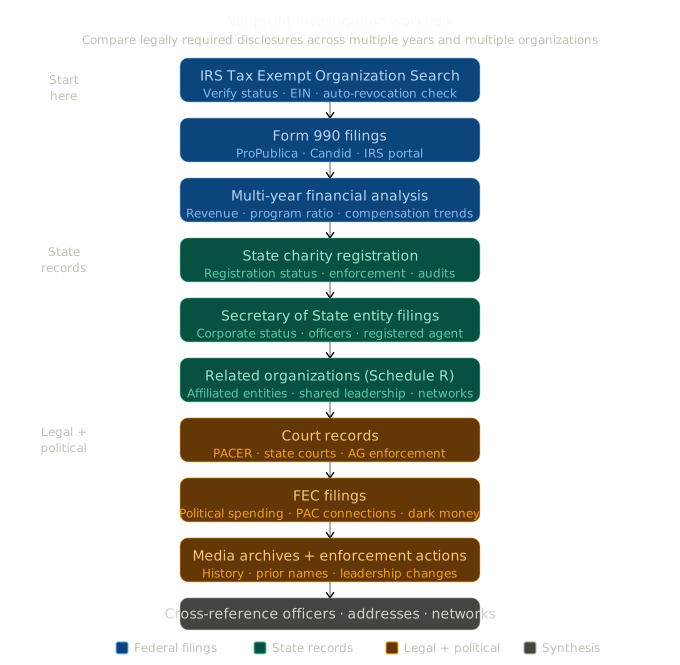
The Complete Nonprofit Research Workflow
Free Government Sources
| Database | What It Shows | URL |
|---|---|---|
| IRS Tax Exempt Organization Search | Tax-exempt status, 990 filings | apps.irs.gov/app/eos |
| IRS Auto-Revocation List | Organizations that lost tax-exempt status | apps.irs.gov/app/eos/forwardToBulkDownload |
| ProPublica Nonprofit Explorer | Searchable 990 database, multi-year comparisons | projects.propublica.org/nonprofits |
| Candid / GuideStar | Nonprofit profiles and 990 filings | candid.org |
| NASCO State Regulator Directory | Links to all state charity regulators | nasconet.org |
| FEC Data | Political spending disclosures | fec.gov/data |
| PACER | Federal court records | pacer.gov |
| PACER Case Locator | Nationwide federal case search | pcl.uscourts.gov |
OSINT Applications for Nonprofit Research
Nonprofit investigation connects naturally to open-source intelligence techniques. The same cross-referencing methodology that identifies beneficial owners in property and business research applies directly to nonprofit networks — the same individuals appearing across multiple 990 filings, Secretary of State registrations, and court records in different roles reveals the controlling structure behind a nonprofit network.
Address searches are particularly useful in nonprofit investigations. When multiple charities, consulting firms, and political organizations share the same mailing address, it often indicates a network of related entities controlled by the same individuals. Searching a shared address across IRS TEOS, Secretary of State portals, and court records simultaneously surfaces the full network in a way that no single source reveals.
Digital footprint research — searching officer names across social media, professional profiles, and business registrations — often surfaces connections between nonprofit leadership and for-profit entities or political organizations that don’t appear in any single filing.
→ Related guide: OSINT Tools for Beginners
→ Related guide: How Asset Searches Work
Common Mistakes That Produce Incomplete Results
Stopping at the nonprofit’s website. Marketing language is not evidence. Always verify claims through official filings.
Reviewing only one year of Form 990. A single year may look reasonable while hiding a trend. Always compare at least three consecutive years.
Ignoring related organizations. Schedule R is where nonprofit networks become visible. Never treat a single organization as isolated without checking its related entity relationships.
Confusing state incorporation with federal tax exemption. The state Secretary of State filing and the IRS exemption status must both be checked separately.
Ignoring the auto-revocation list. Organizations that have lost their tax-exempt status may still appear as active in some databases. Always confirm current status through the IRS portal directly.
Not checking state charity registration. Federal 990 filings don’t confirm compliance with state charitable solicitation laws. Organizations actively fundraising without state registration may be violating state law.
Frequently Asked Questions
How do I find out if a charity is legitimate? Search apps.irs.gov/app/eos to confirm current tax-exempt status. Then review Form 990 filings through ProPublica Nonprofit Explorer to verify the organization files annual returns and that its financial ratios are reasonable.
What is a reasonable program spending ratio for a charity? Most charity evaluators consider 65–75% or higher in program spending as reasonable. Organizations spending less than half their expenses on programs, or more than 35% on fundraising, warrant additional scrutiny.
What is Form 990 and where can I find it? Form 990 is the annual information return most tax-exempt organizations must file with the IRS. It’s publicly available through ProPublica Nonprofit Explorer, Candid, and the IRS Tax Exempt Organization Search.
Can a nonprofit lose its tax-exempt status? Yes. The IRS automatically revokes tax-exempt status for organizations that fail to file Form 990 for three consecutive years. Organizations can also lose status through IRS enforcement action.
How do I investigate a charity scam? Verify current IRS tax-exempt status, search for missing 990 filings, check state charity registration, search for enforcement actions through state attorneys general, and analyze the 990 for scam patterns — excessive fundraising expenses, minimal program spending, and payments to insider-controlled vendors.
Final Thoughts
Nonprofit investigations work because the law requires disclosure. Form 990 filings, state charity registrations, and entity records provide a transparent view into how a nonprofit actually operates — not how it presents itself. When these records are compared across multiple years and multiple organizations, the patterns that reveal governance failures, financial misuse, and organizational networks become visible.
Effective nonprofit investigations rely on comparing legally required disclosures across multiple years and multiple organizations. The filings exist. The investigative skill lies in recognizing the patterns they reveal.
Related Guides
- How to Research a Business and Its Owners
- OSINT Tools for Beginners
- How Asset Searches Work
- Best Government Databases for Background Research
- What Is PACER? A Beginner’s Guide to Federal Court Records
- How Court Records Work in the United States
Disclaimer: This article is for informational purposes only and does not constitute legal advice. Nonprofit research methods and regulatory requirements vary by jurisdiction. Always verify important findings through official government sources. This article may contain affiliate links — we may earn a commission if you purchase through them, at no extra cost to you.