
Identity theft occurs when someone uses another person’s personal information — a Social Security number, financial account details, or other identifying data — without authorization to commit fraud, open accounts, obtain employment, or access services in that person’s name.
Quick Answer: Identity theft is usually detected through unusual financial activity, unexpected credit inquiries, unfamiliar accounts on a credit report, or official notices about transactions you didn’t initiate. Understanding the signs of identity theft and knowing how to investigate identity theft early can prevent long-term credit damage. Report confirmed identity theft to the FTC at identitytheft.gov — their personalized recovery plan guides every subsequent step.
Many victims lose time and money not because the fraud was sophisticated, but because early warning signs were ignored or misattributed. Understanding what to look for — and knowing the identity theft investigation steps to take when something seems wrong — is the most effective protection against extended damage.
⚠️ Legal Notice: Identity theft investigations must comply with applicable privacy and financial regulations. This guide explains lawful steps victims can take to investigate identity theft and does not constitute legal advice. Victims experiencing significant financial loss should consider consulting law enforcement or a licensed attorney.
Why This Guide Is Reliable
inet-investigation.com publishes research-based guides built on primary government sources, investigative practice, and public records law. All sources cited link to official government websites or primary legal references. For jurisdiction-specific legal questions, consult a licensed attorney or the relevant government agency.
Identity Theft vs. Credit Card Fraud
Many people use these terms interchangeably — they are different problems with different scopes and different recovery processes.
Credit card fraud occurs when someone uses an existing credit card number to make unauthorized purchases. The fraudulent charges appear on your existing account. Resolution typically involves disputing the charges with your card issuer, which initiates a chargeback process. Most credit card fraud cases resolve within days to weeks.
Identity theft is broader. It involves using personal identifying information — a Social Security number, date of birth, or combination of identifying details — to open new accounts, obtain employment, file tax returns, claim government benefits, or impersonate someone across multiple systems. Identity theft cases often require a longer investigation because fraudulent activity may appear across credit accounts, court records, government databases, and public records simultaneously.
Credit card fraud is a symptom that sometimes points to identity theft. If your card number was obtained through a data breach that also exposed your Social Security number, the unauthorized charge may be the first visible sign of a much larger compromise.
How Identity Theft Happens
Understanding how criminals obtain personal information helps identify where a breach may have occurred in your specific situation.
Data breaches — large-scale exposures of personal information stored by companies or government agencies. Billions of records have been exposed in breaches over the past decade, including names, Social Security numbers, email addresses, and financial account details.
Data broker exposure — personal information aggregated by data brokers from public records, commercial transactions, and other sources is a significant attack surface. Many identity theft investigations reveal that criminals obtained foundational information — name, address history, relatives, and phone numbers — from data broker databases before targeting victims with phishing or account takeover attacks. Data broker databases are themselves targets for breach, and the detailed profiles they compile provide criminals with the information needed to commit identity fraud with credibility.
Phishing and social engineering — fraudulent emails, text messages, and phone calls that impersonate banks, government agencies, or employers trick victims into revealing login credentials, Social Security numbers, or account information.
Malware and compromised devices — malicious software installed on computers or phones can capture passwords, banking credentials, and keystrokes silently over extended periods.
Physical theft — mail theft, stolen wallets, or discarded documents containing account numbers or Social Security numbers provide criminals with the raw material for identity fraud.
Synthetic identity construction — criminals combine a real Social Security number with a fabricated name and other details to create a synthetic identity. This type is particularly difficult to detect because the victim may not have credit activity to monitor under the name being used.
→ Related guide: Understanding Data Brokers
→ Related guide: What Information About a Person Is Publicly Available?
The Legal Framework
| Law | What It Covers | Relevance to Identity Theft |
|---|---|---|
| Fair Credit Reporting Act (FCRA) | Regulates consumer reporting agencies | Gives victims the right to dispute fraudulent accounts and place fraud alerts |
| Identity Theft and Assumption Deterrence Act | Federal identity theft statute | Makes identity theft a federal crime |
| Fair and Accurate Credit Transactions Act (FACTA) | Amends FCRA | Gives consumers the right to free annual credit reports and fraud alert protections |
| Gramm-Leach-Bliley Act (GLBA) | Protects financial information | Governs how financial institutions protect and disclose personal data |
| State identity theft laws | Vary by jurisdiction | Many states have additional statutes and victim assistance programs |
Source: Fair Credit Reporting Act — 15 U.S.C. § 1681 — Cornell LII
The FCRA is the most important law for identity theft victims because it governs how credit bureaus handle fraudulent accounts and dispute requests. Under the FCRA, victims have the right to place fraud alerts and credit freezes, dispute inaccurate information, and receive free copies of their credit reports. Credit bureaus are legally required to investigate disputes within 30 days.
The 12 Most Common Warning Signs of Identity Theft
1. Unfamiliar accounts on your credit report — accounts you didn’t open appearing in your credit history are the most definitive sign of credit-based identity theft.
2. Unexpected credit inquiries — hard inquiries from lenders you never contacted indicate someone is applying for credit in your name.
3. Bills or collection notices for accounts you never opened — billing statements, collection letters, or debt collection calls for accounts you have no knowledge of.
4. Unauthorized financial transactions — purchases, transfers, or withdrawals on bank or credit card statements you didn’t make.
5. Your credit card is declined unexpectedly — a card declined when it shouldn’t be may indicate fraudulent charges draining the account.
6. Missing expected mail — bills, bank statements, or tax documents that stop arriving may indicate mail redirection by a fraudster.
7. Unexpected change-of-address confirmation — receiving a notice that a change of address was filed when you didn’t request one.
8. IRS notice about a duplicate tax return — the IRS notifies you that a return was already filed under your Social Security number.
9. Government benefits denial — denial of unemployment, Social Security, or other government benefits because someone else is already collecting under your identity.
10. Medical bills for services you didn’t receive — medical identity theft occurs when someone uses your insurance or identity to receive medical care.
11. Employer notification of unreported income — your employer or the IRS notifies you of income from a job you didn’t hold, indicating someone used your Social Security number for employment.
12. Your email or online accounts are locked — login failures or password reset notifications you didn’t request may indicate account takeover.
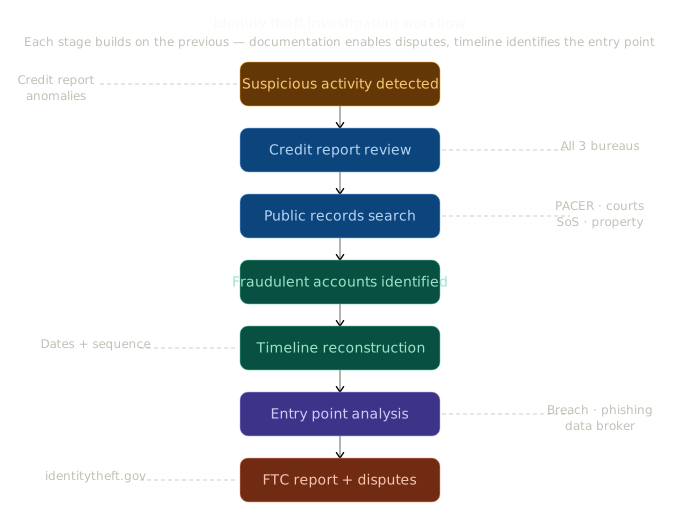
Identity Theft Investigation Workflow
[INSERT DIAGRAM HERE]
The investigation follows a consistent sequence regardless of the type of identity theft involved. Each stage builds on the previous one — documentation enables disputes, timeline reconstruction identifies the entry point, and entry point analysis guides prevention.
Step-by-Step Identity Theft Investigation
Step 1 — Pull All Three Credit Reports
Go to AnnualCreditReport.com (annualcreditreport.com) — the only federally authorized source for free credit reports. Request reports from all three bureaus: Equifax, Experian, and TransUnion. Review each one separately — fraudulent accounts may appear on one bureau’s report but not the others.
Look for accounts you didn’t open, credit inquiries from lenders you never contacted, addresses you’ve never lived at, employers you’ve never worked for, and payment history on accounts you don’t recognize.
Step 2 — Check for Breach Exposure
Go to HaveIBeenPwned (haveibeenpwned.com) and search every email address associated with your identity. The site shows which data breaches your email has appeared in, which services were compromised, and what types of data were exposed. This helps identify the likely entry point for any identity theft.
Step 3 — Search Public Records for Fraudulent Activity in Your Name
Identity thieves don’t just open financial accounts — they sometimes use stolen identities to form business entities, sign leases, appear in court proceedings, or file for bankruptcy. Public records can surface this activity that credit reports never capture.
PACER search — go to pcl.uscourts.gov and search your full name. A bankruptcy filing, civil judgment, or federal criminal case in your name that you have no knowledge of is a serious identity theft indicator.
State court portal search — search your name in the state court portals for every state where you’ve lived. Eviction filings, civil judgments, and criminal cases you don’t recognize may indicate identity theft.
Secretary of State business search — search your name in state SoS portals. A business entity formed in your name that you didn’t create indicates identity theft in a business context.
County property records — search your name in county recorder portals. A fraudulent deed, mortgage, or lien filed in your name is a serious form of property title fraud.
→ Related guide: How to Run a Background Check on Yourself — [inet-investigation.com]
Step 4 — Check Data Broker Profiles for Suspicious Information
Search your name on major people-search sites — BeenVerified, Spokeo, Whitepages — and review what appears in your profile. Look for addresses you’ve never lived at, relatives or associates you don’t recognize, phone numbers you’ve never used, and business associations you didn’t create.
Unexpected addresses or associations in data broker profiles can point you toward jurisdictions where fraudulent activity may have occurred in official records.
→ Related guide: How to Remove Your Information From People-Search Sites — [inet-investigation.com]
Step 5 — Document All Findings
Before taking any action, document everything. Screenshot every fraudulent account, every unexpected inquiry, every suspicious record. Save copies of all credit reports. Create a timeline showing the earliest detected fraudulent activity and the sequence of events. This documentation is required for dispute processes, police reports, and FTC filing.
Step 6 — Reconstruct the Timeline
Work backward from the earliest fraudulent activity to identify when your information was likely compromised. Identifying the earliest fraudulent activity helps investigators determine when the identity theft began and which compromised account or data breach likely exposed the personal information. Credit inquiries have dates. Account opening dates appear on credit reports. Breach dates are searchable through HIBP.
Step 7 — Determine the Entry Point
Identifying how your information was obtained helps protect remaining accounts and prevent additional fraud. If breach exposure is confirmed through HIBP, change passwords on all accounts using the same credentials immediately. If mail theft is suspected, contact USPS to verify no change-of-address requests were filed.
Step 8 — Report to the FTC
File an identity theft report at identitytheft.gov — the FTC’s official identity theft resource. The FTC generates a personalized recovery plan specific to your situation, provides an official Identity Theft Report legally recognized for dispute purposes, and guides you through each step of the recovery process.
Step 9 — Place a Fraud Alert or Credit Freeze
Fraud alert — contact one credit bureau (required to notify the others) and request a fraud alert. A standard fraud alert lasts one year. An extended fraud alert for confirmed victims lasts seven years.
Credit freeze — contact each bureau separately to freeze your credit file. A freeze prevents any new credit accounts from being opened in your name, is free, and can be temporarily lifted when needed.
- Equifax: equifax.com/personal/credit-report-services
- Experian: experian.com/freeze/center.html
- TransUnion: transunion.com/credit-freeze
Step 10 — Dispute Fraudulent Accounts
Contact each financial institution associated with fraudulent accounts and dispute them using your FTC Identity Theft Report as documentation. Contact the credit bureaus to dispute fraudulent accounts on your credit reports. Under the FCRA bureaus must investigate disputes within 30 days.
Step 11 — File a Police Report
File a police report with your local law enforcement agency. Some financial institutions require a police report rather than just an FTC report. The police report creates an official record useful if the identity theft escalates.
Free Investigation Tools
| Tool | What It Does | URL |
|---|---|---|
| AnnualCreditReport.com | Free credit reports from all three bureaus | annualcreditreport.com |
| HaveIBeenPwned | Email breach exposure check | haveibeenpwned.com |
| identitytheft.gov | FTC identity theft reporting and recovery plan | identitytheft.gov |
| PACER Case Locator | Federal court records search | pcl.uscourts.gov |
| State court portals | State civil and criminal records | Varies by state |
| Equifax fraud center | Fraud alerts and credit freeze | equifax.com |
| Experian freeze center | Credit freeze | experian.com/freeze |
| TransUnion fraud | Fraud alerts and freeze | transunion.com/credit-freeze |
| SSA my account | SSA earnings record check | ssa.gov/myaccount |
| IRS identity protection | Tax identity theft tools | irs.gov/identity-theft-central |
Paid Monitoring and Recovery Tools
| Tool | Price | Best Use | FCRA Status |
|---|---|---|---|
| IdentityIQ | ~$29/month | Credit monitoring + identity theft insurance | FCRA compliant |
| IdentityForce | ~$20–$30/month | Monitoring + dark web surveillance | FCRA compliant |
| Aura | ~$12–$15/month | All-in-one monitoring, VPN, antivirus | FCRA compliant |
| DeleteMe | ~$129/year | Data broker opt-out — reduces exposure | Not applicable |
| Experian IdentityWorks | ~$10–$25/month | Credit + dark web monitoring | FCRA compliant |
| LifeLock | ~$9–$30/month | Identity monitoring + restoration service | FCRA compliant |
Prevention: Credit Freezes vs. Fraud Alerts
| Feature | Fraud Alert | Credit Freeze |
|---|---|---|
| How long it lasts | 1 year (7 years for confirmed victims) | Indefinite until lifted |
| How to place | Contact one bureau — they notify the others | Contact each bureau separately |
| Effect on new credit | Requires extra identity verification | Blocks all new credit inquiries |
| Cost | Free | Free |
| Best for | General precaution after a breach | Maximum protection after confirmed theft |
| Affects existing accounts? | No | No |
A credit freeze is the stronger protection. If you’ve confirmed identity theft or been notified of a significant data breach containing your Social Security number, a credit freeze at all three bureaus immediately prevents any new account from being opened in your name.
How Long Identity Theft Recovery Takes
Simple cases (one or two fraudulent accounts, no criminal or government records) — typically 2–6 months. Most credit bureau disputes resolve within 30 days.
Complex cases (multiple accounts, tax identity theft, employment identity theft, or fraudulent court records) — can take 1–2 years. Tax identity theft resolution through the IRS often takes 6–18 months.
Synthetic identity theft — among the most complex to resolve because a credit history may have been built under a different name using your SSN.
The FTC’s identitytheft.gov tracks your recovery progress and provides updated guidance as each step is completed.
Common Mistakes That Extend Identity Theft Damage
Ignoring small irregularities. A single unfamiliar charge or one unexpected credit inquiry may be an early sign of larger fraud. Identity thieves often test accounts with small transactions before escalating.
Pulling credit from only one bureau. Fraudulent accounts may appear on one bureau’s report and not the others. Always pull all three reports from AnnualCreditReport.com.
Not checking public records. Most identity theft guides focus exclusively on financial accounts. Identity thieves also open businesses, create fraudulent court filings, and use stolen identities for employment — all of which leave public records traces that credit reports don’t capture.
Waiting too long to place a credit freeze. A fraud alert requires identity verification but doesn’t block new credit. A credit freeze blocks it entirely and costs nothing.
Disputing without documentation. Filing disputes before gathering complete documentation — credit reports, FTC report, timeline, fraudulent account details — produces incomplete disputes that may not resolve in your favor.
Not checking for tax identity theft. Create an IRS Identity Protection PIN through the IRS website before filing season — this prevents anyone from filing a return using your SSN without the PIN.
Frequently Asked Questions
What are the first signs of identity theft? The most common early signs are unfamiliar accounts on a credit report, unexpected credit inquiries, and billing statements or collection notices for accounts you didn’t open. Tax notices about returns you didn’t file and government benefit denials are also early indicators.
How do I check if someone is using my Social Security number? Review all three credit reports at AnnualCreditReport.com for unfamiliar accounts. Check your SSA earnings record at ssa.gov/myaccount for unrecognized employment. File taxes early to prevent someone else filing first. Check IRS records for unexpected tax filings at irs.gov/identity-theft-central.
Should I file a police report for identity theft? Yes. A police report creates an official record and is required by some financial institutions for dispute purposes. File with your local police department after filing with the FTC at identitytheft.gov.
Can I freeze my credit for free? Yes. Credit freezes are free at all three bureaus under federal law.
How long does identity theft recovery take? Simple cases resolve within 2–6 months. Complex cases involving tax fraud, employment fraud, or multiple accounts can take one to two years.
What is the difference between identity theft and credit card fraud? Credit card fraud involves unauthorized use of an existing account — typically resolved quickly through chargebacks. Identity theft is broader, involving use of personal identifying information to open new accounts, file tax returns, obtain employment, or impersonate someone across multiple systems. Identity theft requires a longer investigation across more systems.
Final Thoughts
Identity theft is serious but recoverable — and early detection dramatically reduces both the scope of damage and the time required for resolution. The signs of identity theft investigation process is systematic: pull all three credit reports, check breach exposure, search public records for fraudulent activity in your name, document everything, report to the FTC, place a credit freeze, and dispute fraudulent accounts through proper channels.
The step most people skip is the public records check. Financial accounts are the most visible sign of identity theft — but criminal cases, business entities, court judgments, and property transactions filed in your name are equally serious and require the same investigation to uncover.
Related Guides
- How to Run a Background Check on Yourself
- Understanding Data Brokers
- How to Remove Your Information From People-Search Sites
- What Information About a Person Is Publicly Available?
- What Is a Background Check?
- OSINT Tools for Beginners
Disclaimer: This article is for informational purposes only and does not constitute legal advice. Laws governing identity theft and financial fraud vary by jurisdiction. Victims should contact appropriate authorities and financial institutions to resolve fraudulent activity. This article may contain affiliate links — we may earn a commission if you purchase through them, at no extra cost to you.